
Thursday, March 8, 2012

Shaped Note Singing

Shape notes are a music notation designed to facilitate congregational and community singing. The idea behind shape notes is that the parts of a vocal work can be learned more quickly and easily if the music is printed in shapes that match up with the solfege syllables with which the notes of the musical scale are sung. The notation, introduced in 1801, became a popular teaching device in American singing schools. Shapes were added to the note heads in written music to help singers find pitches within major and minor scales without the use of more complex information found in key signatures on the staff.
Shape notes of various kinds have been used for over two centuries in a variety of music traditions, mostly sacred but also secular, originating in New England, practiced primarily in the Southern region of the United States for many years. Although seven-shape books may not be as popular as in the past, there are still a great number of churches in the South, in particular Primitive Baptist, Independent Fundamental Baptist, and Churches of Christ, as well as Conservative Mennonites throughout North America, that regularly use seven-shape songbooks in Sunday worship.1

Sacred Harp singing is a tradition of sacred choral music that took root in the Southern region of the United States. It is part of the larger tradition of shape note music. Sacred Harp music is performed a capella (voice only, without instruments) and originated as Protestant Christian music. The songs sung are primarily from the book The Sacred Harp.2
Links
Sacred Harp Singing
University of Mississippi: Sacred Harp Singing
Smithsonian Education: A Shape-Note Singing Lesson
Minnesota Public Radio: Shaped Note Singing
Encyclopedia of Southern Culture: Shape-Note Singing Schools
My Mother by Ann Taylor
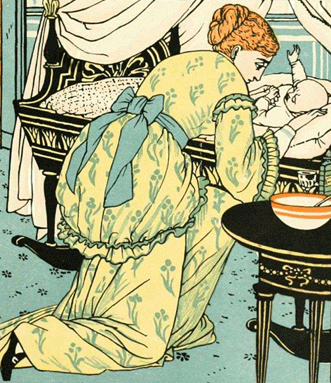
"My Mother," a poem written by Ann Taylor (1783 –1866) and illustrated by Walter Crane. Follow link below:
Thursday, February 16, 2012
The Deserted House
The Deserted House
by Alfred Tennyson
by Alfred Tennyson
Life and Thought have gone away
Side by side,
Leaving door and windows wide:
Careless tenants they!
All within is dark as night:
In the windows is no light;
And no murmur at the door,
So frequent on its hinge before.
Close the door, the shutters close,
Or thro' the windows we shall see
The nakedness and vacancy
Of the dark deserted house.
Come away: no more of mirth
Is here or merry-making sound.
The house was builded of the earth,
And shall fall again to ground.
Come away: for Life and Thought
Here no longer dwell;
But in a city glorious--
A great and distant city--have bought
A mansion incorruptible.
Would they could have stayed with us!
Tuesday, February 7, 2012
Charles Dickens

Charles Dickens, born February 7, 1812, 200th birthday today, also see earlier post, Telescopic Philanthropy.
Chesterton argues that the disappearance of Victorian greatness is mirrored by the disappearance of Christian hope, a virtue that suffused English culture in the early 19th century and was given its voice in Dickens’ novels.1The Theology of Charles Dickens and On Reading Dickens
Charles Dickens Free Google eBooks
Monday, February 6, 2012
The Patience of Hope
The Patience of Hope
by Christina Rossetti
by Christina Rossetti
The flowers that bloom in sun and shade
And glitter in the dew,
The flowers must fade.
The birds that build their nest and sing
When lovely spring is new,
Must soon take wing.
The sun that rises in his strength
To wake and warm the world,
Must set at length.
The sea that overflows the shore
With billows frothed and curled,
Must ebb once more.
All come and go, all wax and wane,
O Lord, save only Thou
Who dost remain
The Same to all eternity.
All things which fail us now
We trust to Thee.
Subscribe to:
Posts (Atom)